

Death and Divinity: Our Desire to Know Our Future Through Tarot Cards
On fortune telling, ancient practices, and human nature.

As I walked past all the market stalls along the streets of South Bank, I was inevitably drawn into tent of the fortune teller. Atop of the rich purple tablecloth were two large crystals, and in-between them, a stack of neatly piled tarot cards. Apart from her wrists stacked with gold bangles, the lady in front of me really didn’t look like the fortune tellers from the movies. While she lacked the head scarf and crystal ball, I really did believe that the deck of cards under the palm of her hands had the power of telling my future.
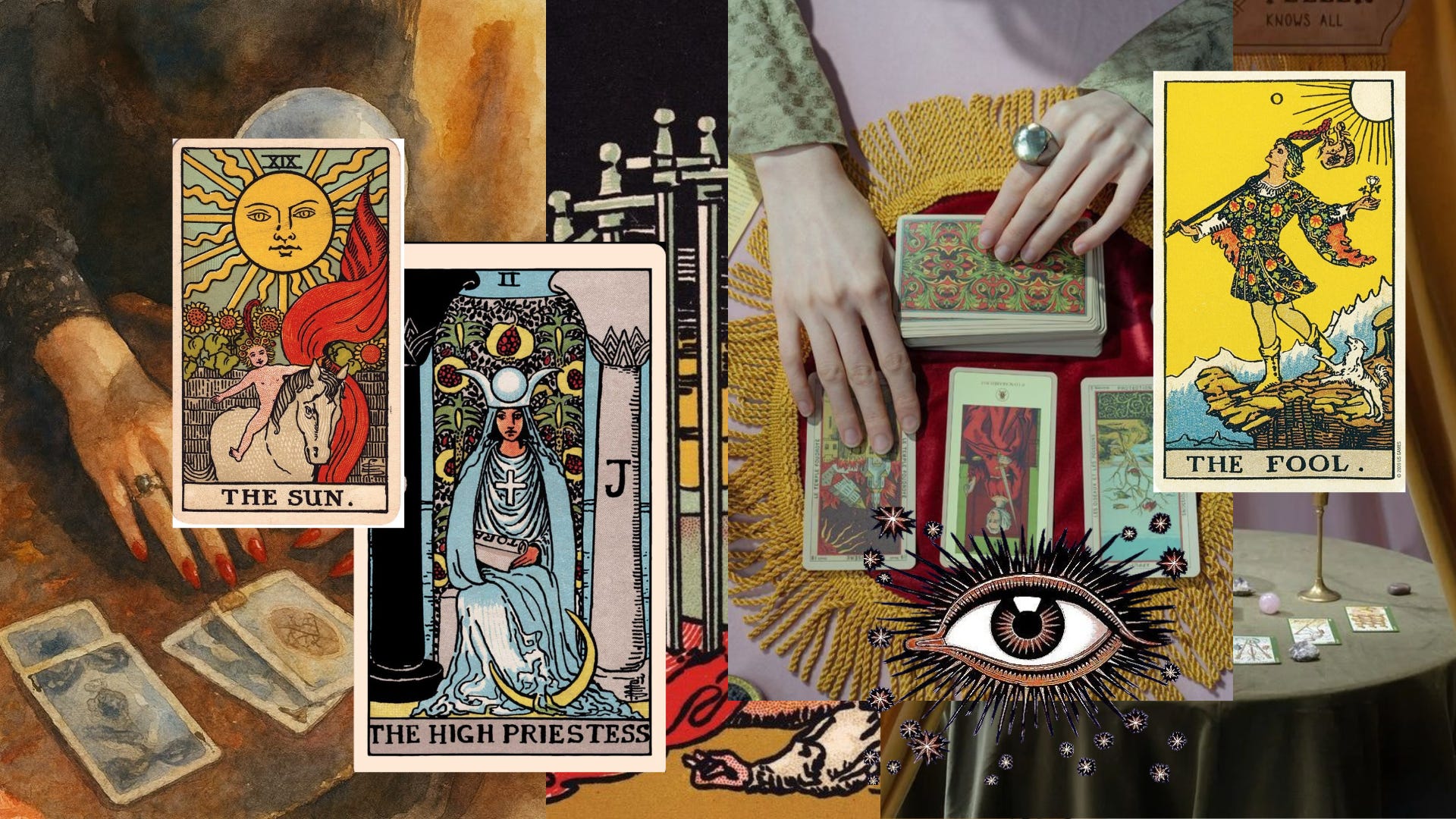
My desire to know and understand the course of my future is not unique to myself. Divination – the practice of seeking knowledge of the future by aid of the supernatural – is found across all cultures and is ubiquitous to the ancient world1. As an attempt to answer questions of the future, people developed predictive systems that could foretell events. Every culture has a divinatory system. Throughout the world, these systems have changed overtime. Unsurprisingly, tarot cards and their unique imagery and magical energy have enthralled people like me for centuries across cultures.
The role of prediction has evolved in different cultures, on different countries, and throughout different centuries. As Juan Francisco, a physic medium based in New York, explained reading tarot cards is a way to understand “being human and life’s journey”2. Humans have been asking the same questions for as long as history has been recorded. Tarot is a card oracle with each card symbolic of certain meanings up for interpretation. A deck consists of 78 cards divided into major and minor arcana, which derives from the Latin word, arcanus, meaning secret3. Over my time, I have had my future read from a Russian deck with images of folk tales and historical legends, a Shadowscapes deck with fantastical and surreal images, and a science deck with symbols of discovery and innovation. In fact, many people collect decks of cards for their unique imagery influenced by many different cultures.
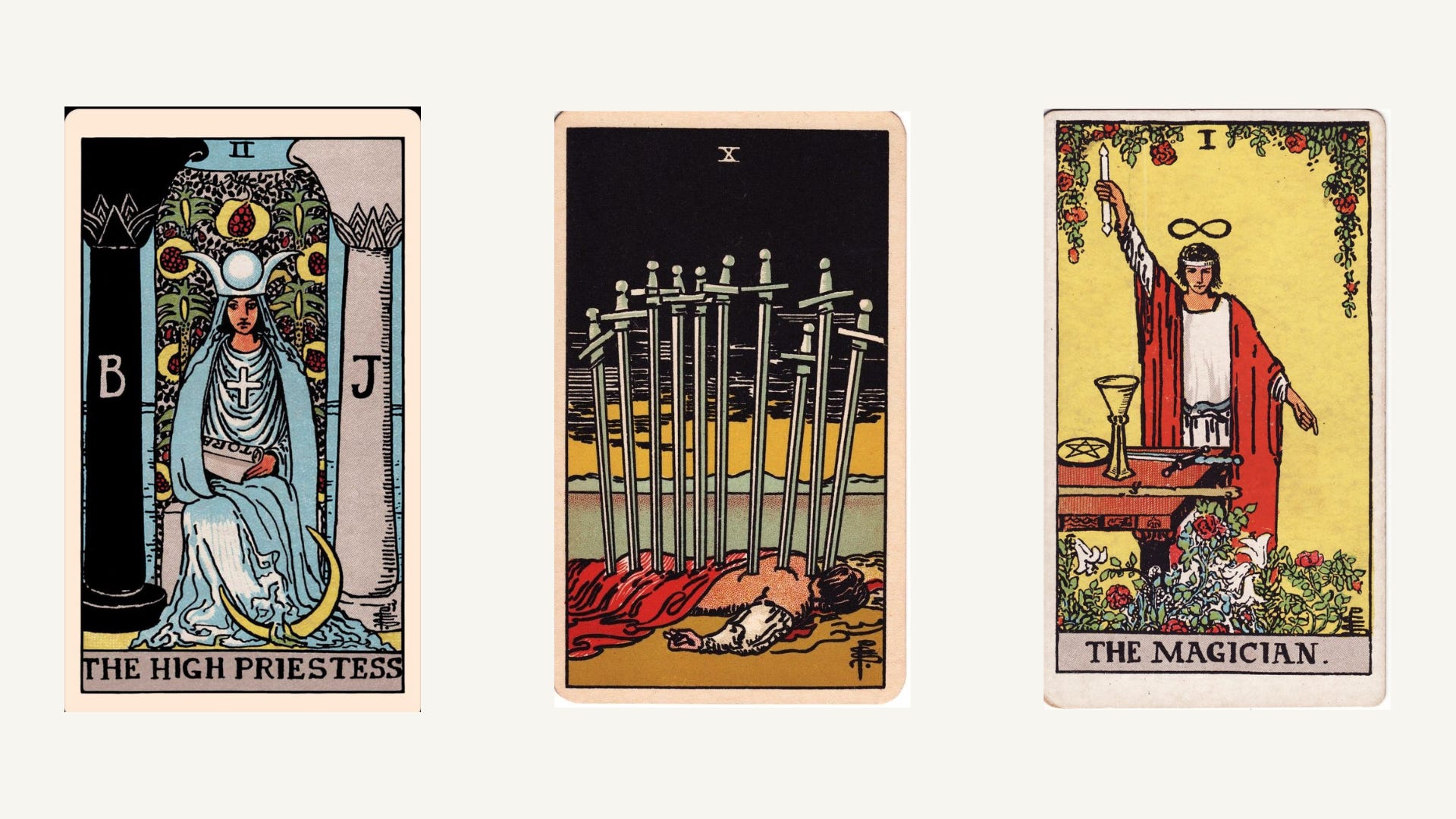
Originally, these were simply playing cards reserved for the wealthy families in Europe. The Northern Italian game, tarocchini, is the earliest example of tarot cards being used in the mid-15th century. Soon, with the onset of the Italian Wars, the game migrated to other regions of Europe. The invention of the printing press made the mass production of tarot cards possible. As a result, the proliferation of tarot across Europe was accompanied by new symbology associated with it in the later 18th century. The association of tarot with the occult and the divine emerged when Frenchman, Jean-Baptiste Alliette, published his own deck for tarot readings in Paris. Dr. Colin Fredericks from Harvard University explains that the resurgence of the occult in the 18thcentury popularised the interpretation of tarot cards for spiritual divination. Alliette’s guidebook, that he published alongside his tarot deck, assigned meaning to each of the cards. Each card was ascribed a spiritual meaning from career ambitions to matters of life and death. While each culture may have specific desired outcomes, like the American Dream in the U.S. or the sex of their child in China, the desire to know the future remains shared.
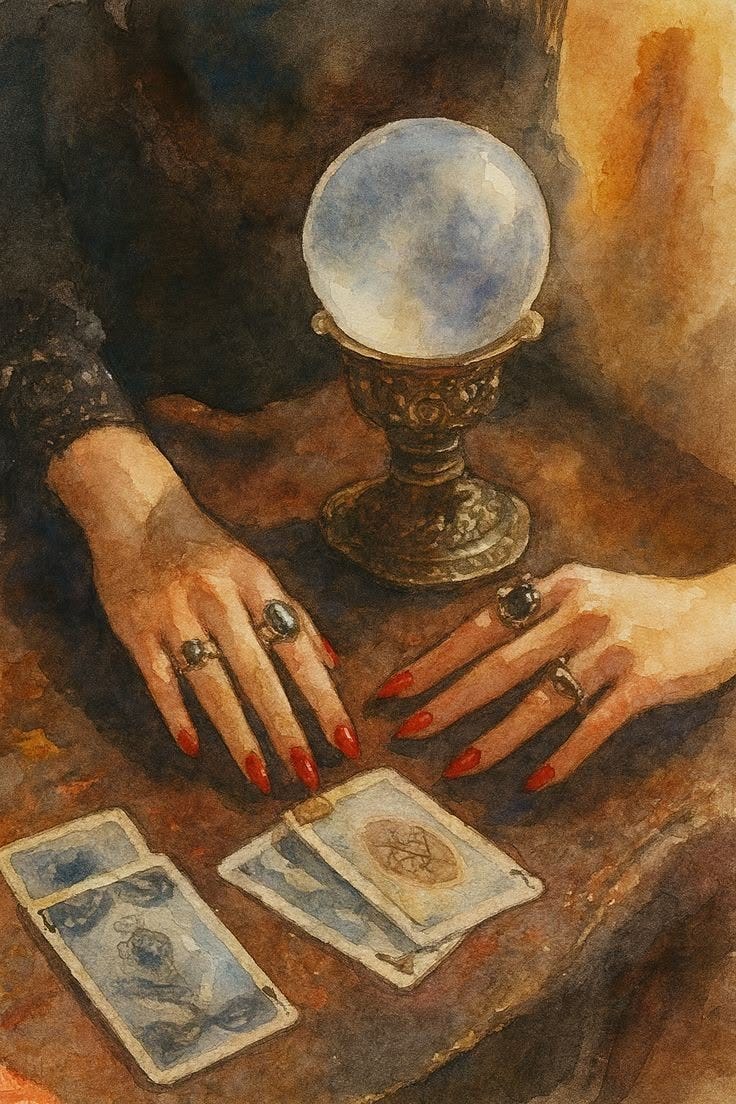
There is a perceived idea that practices of divination are confined to certain cultures. For example, the practice of reading tea leaves is associated with Turkey, but it actually originated in China. Similarly, the practice of tarot reading is widespread and across many cultures. Alliette, like many of his contemporaries, believed the major arcana constituted the Egyptian hieroglyphic Book of Thoth4. The Book of Thoth is a series of ancient texts written by the Egyptian god of writing and knowledge. As a result, Alliette ultimately ascribed ‘Eastern’ traditions to a traditionally ‘Western’ practice.
For me it is quite similar to the exchange between the two artistic traditions of ‘Eastern’ and ‘Western’ Renaissance art. We learnt how artistic traditions are influenced by cross-cultural exchanges. So, if it weren’t for Frenchman Alliette attributing theories of astronomy and ancient Egyptian religion to the cards, tarot would never have the association with the divine that it has today. Later, mystical groups like the Theosophical Society encouraged a new resurgence of tarot in the early 1900s America. Scholarly mystic and creator of the popular Rider-Waite tarot, Arthur Waite characterised the deck as a spiritual history of man. He recognised that tarot was connected to the esoteric knowledge of many cultures. Overtime, each culture that has interacted with tarot has added its own meaning to the deck. Likewise, we too add our own meaning to the deck each time we interpret the readings.
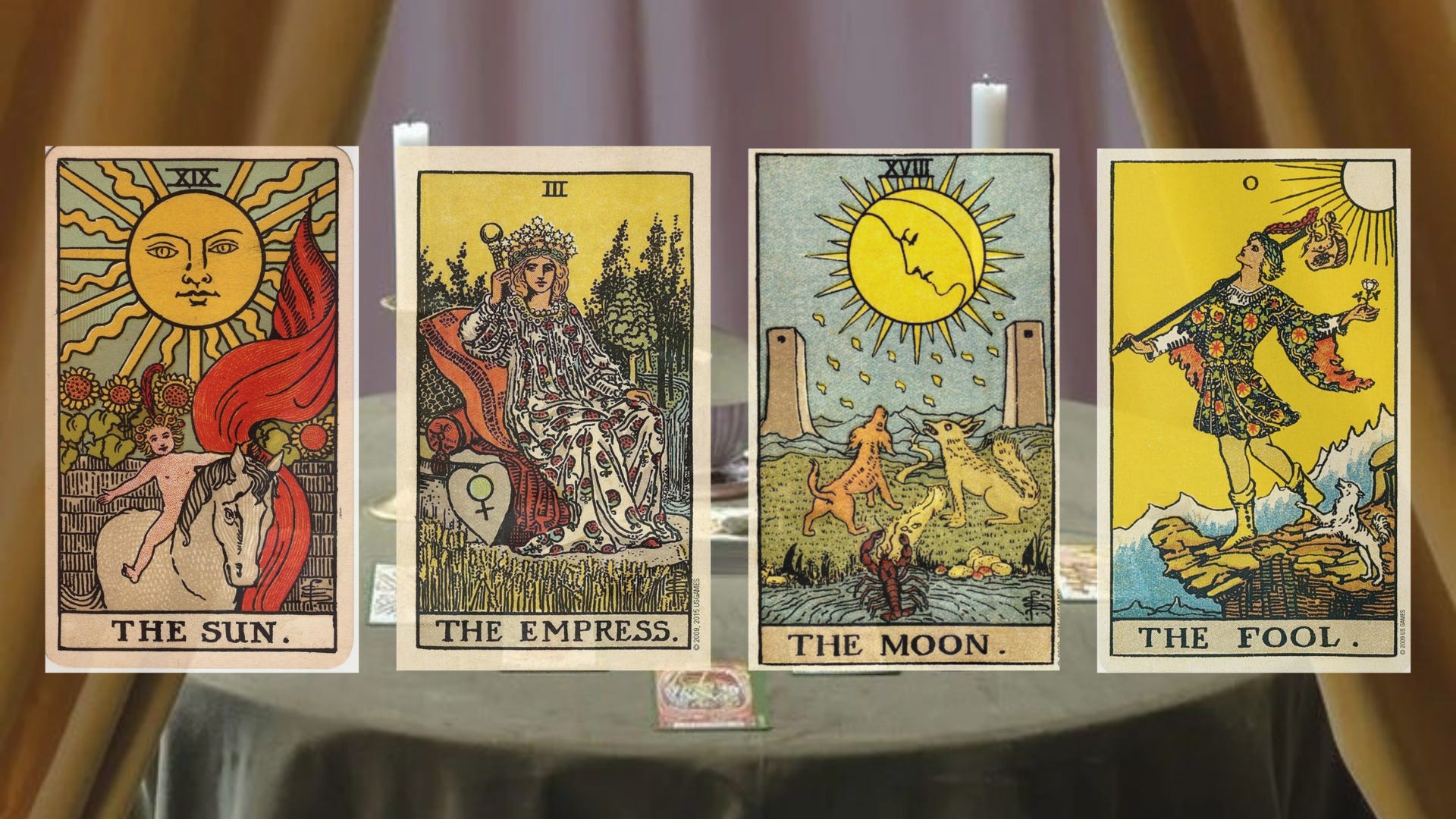
Today, you can have your cards read in virtually every city, and quite literally virtually online. Many people have turned online to TikTok as an escape from their fears of the future. The hashtag, #TarotTok, began trending during the pandemic as people sought to grasp control of their very much uncertain future5. One look at the hashtag shows millions of videos each with hundreds – if not thousands – of comments saying this reading is “a sign”. I think this is a true testament to the fact tarot can really stand the test of time and defy all cultural boundaries. In the age of the internet, what it means to be human has evolved. We are exposed to so much, and the knowledge of all the possible opportunities out there is overwhelming. Humans have constantly desired to understand our place in the world, and ‘woo woo’ or not, tarot cards provide an at least temporary answer to the question. Now, regardless of which town or time zone you are in, the process of divination by the means of tarot cards can easily be accessed.
Tarot cards have evolved from simply playing cards to a source of divine future telling. The word tarot itself is derived from the Italian word, tarocchi, which was synonymous with foolishness in the 16th century (Vitali). So, maybe it is foolish of me to step into the tent of a fortune teller expecting to know the outcome of my life. But maybe it is a moment of release from the anxieties that arise from simply being human. And while I’ll never truly be able to foresee who my future husband will be or where I will live, a piece of me is at peace knowing others too have shared my fears and anxieties. From the Italians to the spiritual French and Russians, and the hippy Americans to the chronically online, we all share the same interest in tarot and the desire to know our futures.
Koch, Ulla. Divination and Omens. Oxford: Oxford Bibliographies, 2021.
Francisco, Juan. Juan Francisco. 20 February 2022. 2 June 2024.
Moore, Barbara. Tarot for Beginners: A Practical Guide to Reading the Cards. Woodbury: Llewellyn Publications, 2010.
Willis, Tony. Magick and the Tarot. Wellingborough: Aquarian, 1988.
Walsh, Hannah. Old meets new as psychics, tarot readers thrive on TikTok, social media. News Report. Brisbane: ABC News, 2022.